
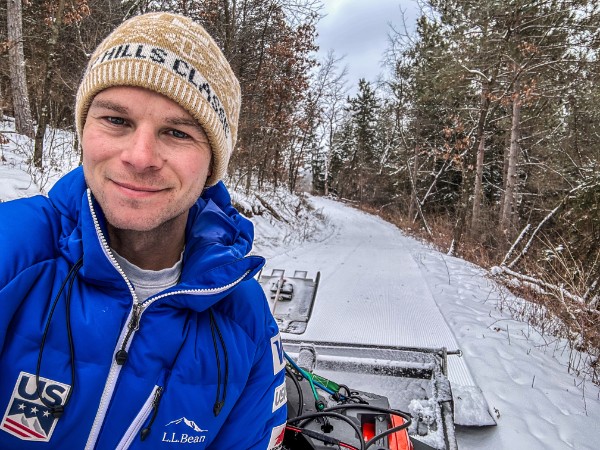
When you spend enough time running in the woods or carving away dirt and tree roots to make trails for running in the woods, it understandably starts to become part of your personality. Your friends and family will notice it before you do – trust me on this. For Walt Ostrander, that connection to the trail is more than a weekend pursuit, it’s a lifelong framework built on dirt, community, and an unshakeable belief in local open spaces.
Long before he took the reins as the Director of CORBA’s annual Fall Back Blast, Walt was a 14-year-old kid in Hayward, Wisconsin, earning one of his first summer paychecks building trails near the local fish hatchery. Raised in a household where his dad also coached his high school cross-country team, Walt grew up with a distinct philosophy printed right on the back of his team shirts: “It’s a trail if I say it is.”
That early exposure to the woods—running deer paths, hunting, and working with CAMBA (Chequamegon Area Mountain Bike Association)— taught him that being embedded in an outdoor community brings people together, while also often bringing out our most authentic, joyful selves. And, none of that happens by accident. Great trails systems and the communities surrounding them are shaped into existence by passionate local user groups.
Finding a Home in Eau Claire and the “Trails for All” Mission
When Walt and his wife moved to Eau Claire in November 2019, they were as surprised as everyone else when a global pandemic shut down normal social life just a few months later. And like many others in the surreal landscape of post-March 2020, Walt went outside to explore his new surroundings and do his social distancing in nature. Then, as the saying goes “That escalated quickly,” and Walt turned to running.
He quickly stumbled upon Lowes Creek County Park, Centennial Park, and the urban trail system connecting parts of town. Seeing a great trail system practically right out his front door validated their move, as did connecting with stalwarts of these local trail systems, Steve Wood and Dale Sonnenburg, and through them, CORBA.
Walt knew that it was easy for a trail organization to build primarily for a single user group, such as mountain bikers, but saw that the local single-track was truly designed for multiple trail users with a wide range of skillsets and abilities. So he welcomed the chance to dig in on volunteer trail workdays, build connections in CORBA and the larger outdoor recreation community, and support CORBA’s motto: Trails for All.
The Fall Back Blast: From Egg Timers to Flagship Event
Walt’s fondest volunteer memory in recent years has been guiding CORBA’s signature trail run: the Fall Back Blast. Walt’s fondest volunteer memory in recent years has been guiding CORBA’s signature trail run, the Fall Back Blast. To understand where the race gets its unique personality, you have to look back at its origins with the Chippewa Valley Trail Runners.
Before it was a formal event, local runners gathered for a collection of informal group runs called the Dirt Series. There were no registration fees, no signed waivers, and no chip timing. The timer was literally an egg timer sitting on a folding table. Runners finished their loop, glanced at the clock, and wrote their time on a notepad. The Fall Back Blast grew out of that same lighthearted culture, and the simple premise all northerners can empathize with: it sucks that we have to set our clocks back for daylight saving time, so let’s do something fun the night before.
CORBA eventually scaled the event into a legitimate, permit-backed, timed race with multiple distance options ranging from a 5K to a 50K. But the people who really run Fall Back Blast work to keep the grassroots heart of the race alive. It persists through traditions like Linda Williams and her legendary post-race chili. When race organizers experimented one year with an alternative food offering, the participant feedback was clear: we appreciate the effort, but bring back Linda’s chili. Walt listened, and Linda returned with her chili the following year. Listening to what the participants and volunteers actually care about is what gives a local event its staying power.
Directing a race is a massive undertaking, often requiring consecutive 16-hour days during race week. But Walt doesn’t like to take sole credit, or even be referred to as “the” Race Director. To him, an event only succeeds when leadership is distributed, and he works on managing volunteers around the core philosophy of Agency.
- Find what they care about: Connect with each volunteer individually to learn why they show up and what specific role excites them.
- Give total ownership: Pass off real responsibility, allow space to learn and make mistakes, and let them truly own their piece of the event.
- Build long-term commitment: When volunteers feel that an event’s success directly relies on their meaningful contribution, they return year after year.
Rather than burning out a single leader, this approach creates a self-sustaining ecosystem of co-directors and dedicated team members who share the load.
A 5-Year Vision: Passing the Baton (and Running the 50K)
Walt believes he’s laid the foundation for a smooth, sustainable evolution for the Fall Back Blast over the next 5 years. On the technical side, that means continuing to refine CORBA’s in-house timing capabilities and equipment. But the foundation on the human and organizational side is growing stronger than ever, partially through CORBA’s recent hiring of its first-ever paid Executive Director. For years, the heavy lifting of event logistics and operations has rested entirely on the shoulders of volunteers. Having dedicated leadership at the organizational level means the transfer of some of that responsibility to an administrative backbone that can support and scale future growth.
Walt’s five-year vision is to bring on one or two key new volunteers each season through this growing support system. With a combination of personal mentorship and backed by CORBA’s professional stability as an organization, he hopes to instill in each volunteer a genuine sense of ownership in race-week operations. New leadership then grows naturally with the event, without requiring any frantic recruiting.
And what is Walt’s personal five-year goal for the race? Having spent the last five or six years directing on race day, he hasn’t been able to pin on a bib for the event in years. His dream is to build a structure so seamless and well-staffed that he can step down to a supporting volunteer role, and finally cross the finish line of the Fall Back Blast 50K himself.
As he reflects on his years with CORBA, Walt notes that the bonds formed through the trails carry over into real life when it matters most. When you are out working with a volunteer team, you are building more than trails or a high-quality event – you’re building human connection. When his family navigated a difficult personal hardship, the people who showed up with meals, prayers, and support were the friends he had met through the local trail running and silent sports community.
“If you talk to anyone that has spent a significant amount of time volunteering with CORBA, whether doing the trails or the events, you’ll never hear the word ‘volunteer’ pass their lips. It’s something more to them than volunteering… It can just be the most important seed that you plant for yourself in the community you live in.”
—Walt Ostrander
Whether you’re clearing fallen limbs after a storm, handing out water at an aid station, or simply sharing a warm bowl of chili after a cold fall run, the trails have a way of bringing people together. And thanks to leaders like Walt and the broader CORBA network, the roots of our local trail community are thriving.