
In the pre-dawn glow of 4:45 a.m. on a mid-summer Wisconsin morning, you are walking back from unlocking the porta-potties (and, apparently as important, locking the toilet paper rolls in place) with a woman you have just met about 90 seconds before. You have already established a connection, and are chatting about the Fall trail race she volunteers at, that you ran last year. At the main hub where Ride Across Wisconsin is being set up for the day, the cool morning air rustles with soft voices, totes and coolers being pulled out of vans and carried to their spots under the dripping tent. Bike rack pieces clank as they are carried and laid out on the shiny grass. The organizer, Heather, looks at the two of you and asks, “Wait, are you two friends?”
The woman you’ve been chatting with smiles and says, “We are now.”
And this, you will learn, is the theme of your volunteering activities with Ride Across Wisconsin. We are now friends.
The two of you help put together bike racks and spread them across a flat stretch of lawn in Phoenix Park, near the tent where a taco feast will be served to the finishers. By the time you are finished, it is close to 5:15 and riders are starting to roll up on their bikes and ramble around, either picking up their race packet or checking in and checking on the promised light breakfast before the mass, 6 a.m. start.
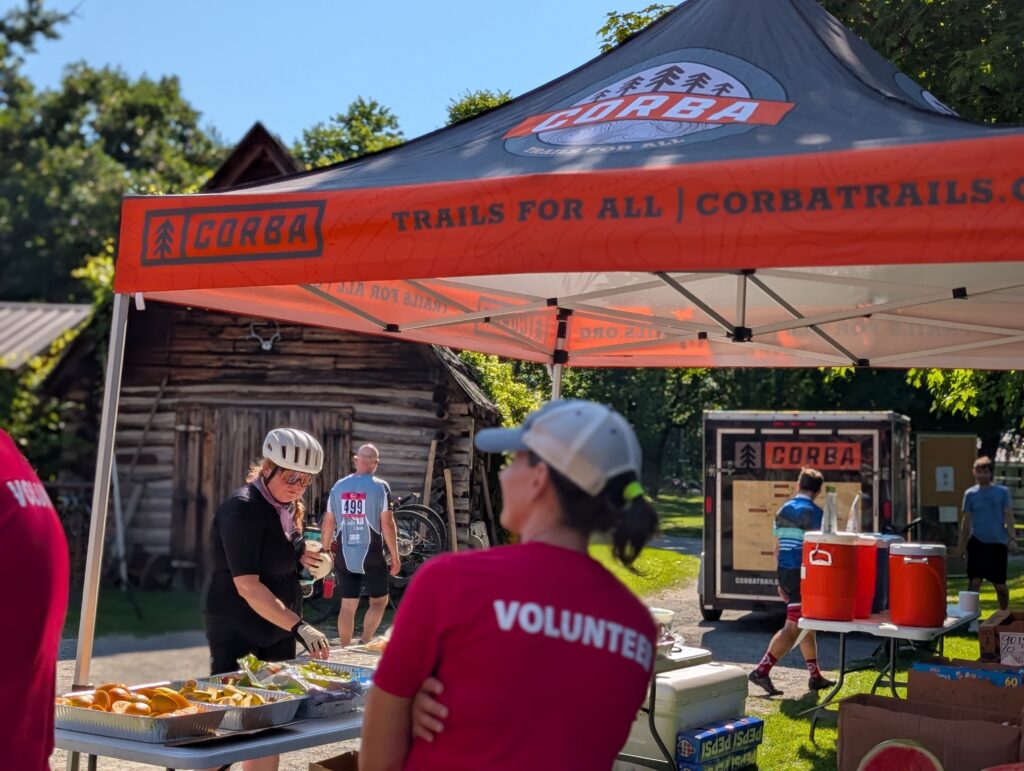
The light breakfast arrived late, courtesy of an unprepared gas station chain, and without any of the requisite accompaniments, like napkins, plastic knives to spread the cream cheese on the bagels, etc… Thankfully, one among you is prepared with a single pocketknife. The pocketknife is the unsung hero of the morning, halving hundreds of bananas, a few dozen bagels, and hundreds of donuts. The knife is handed off to you at some point, and aware of the tide of riders beginning to arrive, you duck your head and press on gamely. Men and women in pristine spandex kit drift down the row of tables, grabbing half a banana, a donut, and a cup of coffee poured by other volunteers. They call greetings to one another and thank you’s to you volunteers behind the table. There is no complaining about the lack of knives for the cream cheese or lack of napkins for donut sticky fingers. Just gratitude for the simple carbs pre-60, 100, or 175-mile bike ride in front of them.
Apart from the bikes rolled along in one hand, and the spandex, they are not dissimilar to the runners you are accustomed to gathering with at early starting lines. The runners may be dressed with more variety, and your starting lines be in the woods, but the atmosphere of anticipation and light nerves are familiar and make you happy to be a part of. The countdown, the cheers as the riders set off in stream that gathers momentum and narrows as it flows away down the street, over 600 riders off on a multi-hour to all day adventure.
You have signed up for one shift, but already know you want more – want to keep being a part of this day and energy and the people you already feel at home with. So that evening you drift back. It is past when the bulk of the riders finished – except for those doing the 175, which took them on a sweeping loop of the hills to the south and west of town, all the way to the Mississippi River and back. You stand under the shifting shade of a pop-up, behind tables with bells, shirts, hats, socks, and other items for sale, as well as the finisher awards of a branded tumbler or gorgeous hand-glazed ceramic mug, filled with drink and food tickets.
When you ask how their ride was, every third rider mentions the hills, and the heat – over 90 that day. But, now they are done. And any endurance event, you realize, is much the same when finished. These riders that have been out, at this point, for over twelve hours, are all a combination of wrecked, relieved, and giddy with the rush you know yourself that comes from pushing so hard and finally being done. Finally having beaten the voice that tells you to quit – at every hill, every aid station that lures you with cheerful volunteers and snacks fit for a five-year-old, and maybe shade and a folding chair. You imagine the voice is the same, whether on a bike or running a trail.
You observe that bikes allow these late finishers to come in with grace. No hobbling and hurling themselves across the line in a final burst of running that only some can make look effortless. The bikes come gliding around the corner and into the short home straight with just enough time for someone to shout out that a rider is coming, and two or three of you to seize up your red bells and jangle them wildly, whooping and shrieking. Because everyone finishing deserves whooping and bells. The riders brake to a smooth stop after the finish line – some greeted by young families who have been waiting with signs and eager to practice their bell waving. They come singly, in pairs, in groups. Racking their bikes, they walk over to you stiffly – sweaty hair, kit plastered in some pattern of white salt, their faces a blend of laughter and shell-shock. One man comes over on the verge of cramping – you know the look – surrounded and shepherded by three small kids, the youngest still held by his wife, who collects his mug for him before ushering him to a chair under the big tent.
“Thank you,” they all say. “Thank you.” As you have so often said to volunteers at aid stations and finish lines. You are, realistically, doing little. Being available, cheerful, showing interest, answering any questions. But you are there, and that seems to matter. You remember the sheer, beautiful gratitude you feel crashing into an aid station area, feeling at the end of some piece of rope that you’ll have to find a bit more of if you are going to leave the aid station in the near future. Having a volunteer rush up with a jug of water to refill anything you offer them, another asking from behind a loaded table, “What can I get you, runner? We have…” Joking with them as you shovel another piece of peanut butter and jelly or slice of watermelon that you may not leave the aid station. Them joking back that they’ll kick you out when they close, but can they get you more mountain dew slushie? Volunteers are the lifeblood of distance sports, and you wonder if this is why they do it. To feel on the receiving end of exhausted gratitude is one of the more rewarding things you can think of in the moment. You know already that you will be doing this again and again.
You tell the riders congratulations. What an accomplishment. They’ve earned it! Please enjoy their spoils of a meal and drinks. They laugh with good-natured acknowledgement, as any endurance athlete must do when earning a cup and a beer for a full day of effort. It’s part of the ethos of the thing. They praise the beauty of the mugs, and of the course. But did they mention the hills?
In between riders, you chat with the others volunteering around you, trade stories in between other tasks; breaking down boxes, unboxing more mugs, clearing and wiping off tables. Chat some more with the woman you’ve been handing out mugs with. She ran a bit when she was younger. Tells you what the ‘running’ shoes were like decades ago, how she started running in Keds. You can’t imagine. Your shoe cabinet is full of shoes made of high-end, injected foams and recycled synthetic uppers and specially compounded Vibram outsoles with lugs that grip everything but wet bridge boards. The same is true for bike technology, riders gliding in on carbon fiber frames and technology the riders of decades ago only dreamed of. She bikes now mostly, has started to sprinkle back in a bit of running so she can keep up with her grandkids, but you have much more in common than less.
The riders have slowed to a trickle as it nears the twilight half-hour of the 12 hours allotted for the 175-mile ride. A handful are still out on course after leaving the last aid station. Your new friend looks up from her phone. “Do you want to pick raspberries tomorrow?” her friend has a huge private patch on her farm, she’s already told you. Used to make wine from them.
“Sure!” you say. You make plans. She says the farm is beautiful and you’ll get so may raspberries. And you will.
The organizer stops at one point and looks at the two of you. “Wait,” she says again. “Are you two friends?”
You laugh. Your new friends says, “We are now.”