
Robert Frost had a thing or two to say about paths. Not just that they diverge in a yellow wood, but also notes about upkeep, observing ‘one was grassy and wanted wear.’ He may not say it in as many words, but it’s clear that trail wanted better maintenance. (If you haven’t read The Road Not Taken recently – take this as your sign to reread this ageless classic…)
Many of us may be like Frost. We head out for a walk, run, or mountain bike ride in a yellow or green wood, and perhaps we just see the trails that are a bit overgrown, or the ones where that recent storm left a bit of washout or debris. Likely, the trails that are in perfect condition we don’t think much about at all. It’s easy to take for granted something that is just working.
But the fact is, every bit of trail that drains perfectly and holds no water after a series of storms, every bridge that spans sensitive or marshy habitat, every switchback that makes your corners smooth and fun… is a piece of the trail design and maintenance network that makes your experience enjoyable. None of these features just sprang into being fully formed. The saying “Rome wasn’t built in a day” applies to many parts of life, and anyone who has ever been involved in trail work KNOWS it applies to trail building.
Now, if you’ve ever put in trails on your own property by mowing some paths through a field, cutting branches and small trees out of the way, or bush-hogging through brush, then it can be easy to think that’s the majority of the work that goes into it. Flag out a meandering path through the woods and cut off the bits of trees that get in the way. If only. If you’ve ever built a trail like this and had it wash out in next year’s spring flooding, this post may be for you!
Good trails are built with an eye towards the natural flow of the landscape. As CORBA Trail Director Jon Strohsal puts it, laying out a trail is like “dancing your way through the woods.” Nobody wants a trail that is just straight and flat, and similarly you can’t throw in too much climb and elevation. Multi-use trails like the ones CORBA helps create, have to be usable, and ideally enjoyable, for bikers, runners, and hikers alike. And one of the secrets to that is hand-cut trails. Many CORBA trails, like the foundational Lowes Creek system or Northwest Park, were hand-built – a method becoming less common in the modern recreational trail landscape.
Single-track trails all used to be hand-cut – frequently known for narrower tread, more challenging climbs, and tighter corners. While most large modern trails systems created after exploding popularity of mountain bikes are machine-built, cut in using mini-excavators, many trail users would agree, even if secretly to a preference for the older, hand-cut styles. A machine cut trail by definition requires a tread mark flat enough to provide a base for the mini-ex, and usually features sweeping corners with heavily built berms. Where one built by hand can meander more efficiently along and over the contours of the landscape, and is less-disruptive to the natural environment.
Each trail carries its own cost. While professional trail building contractors like Rock Solid Trail Contracting or Rogue Trails bid by the job and don’t publish average cost per mile, according the Josh Olson, the Trail Solutions Director of Construction for IMBA, a safe generic estimate for natural-surface single track could be $60-80,000 per mile. And the sky is literally the limit depending on the challenges and features required of the build.
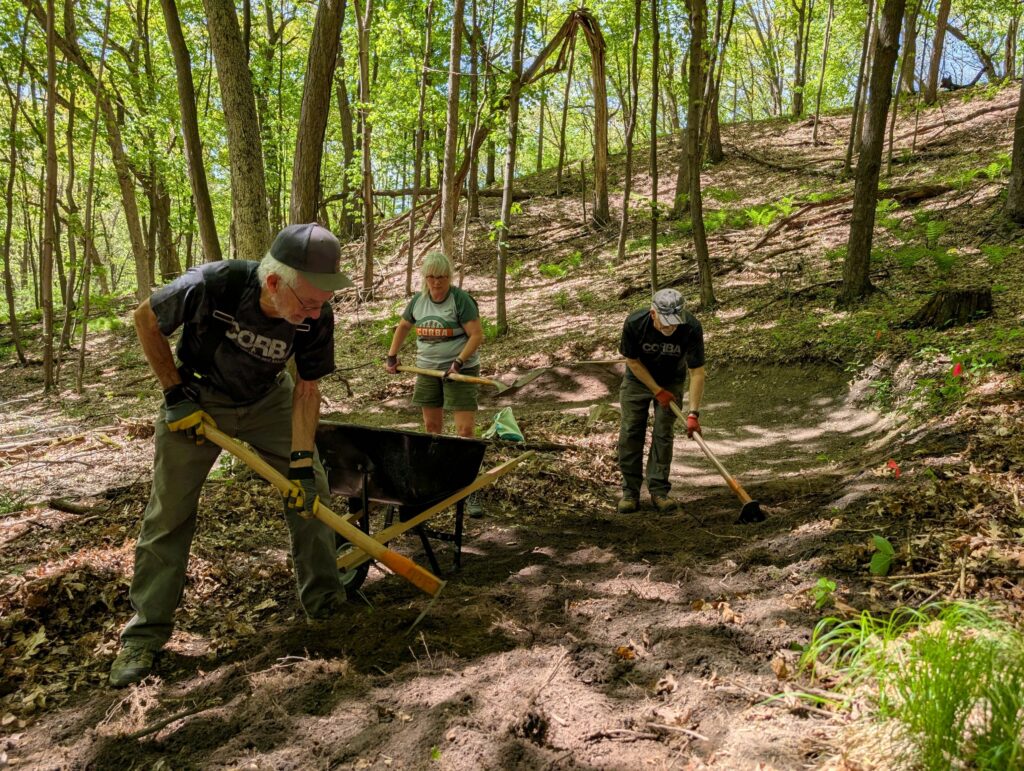
Alternately, the cost of hand-cut trails is the staggering number of volunteer hours required to cut in miles of tread, especially depending on the landscape. If a trail crosses a slope, the builders come in with heavy-duty, sharpened hoes and cut away the dirt and roots to leave a rough bench trail. Dirt seldom goes to waste – often being carted off in wheelbarrows to build up other portions of the trail, such as adding in berms. Then tools called McLeods are often used to scrape and tamp the dirt smooth. Decisions must be made about trees – especially mature trees that provide soil stabilization and forest character, as well as keeping down undergrowth. Cutting in a trail too close to a large, mature tree can damage the root system and destabilize the surrounding soil, where cutting further down or up-slope can create many hours more labor and result in unfavorable lines or erosion patterns. A ‘dance’ with the landscape is right – only a dance demanding incredible amounts of thought and labor in order to appear effortless.
A huge part of that dance includes anticipating where water will flow and making choices to minimize erosion. Trail builders probably spend as much time thinking about where the water will go as where the people using the trail will go. A trail that follows a fall-line too closely can be destroyed in a single-thunderstorm, where a sustainable trail sheds water every chance it gets. This means employing techniques like a 5-degree outslope on bench trails, encouraging water to run across and not down the trail. Or on portions of the trail with significant slope, building in grade reversals to occasionally force the water off the side.
CORBA’s core trail volunteers have taken multi-day classes on trail-building put on by a professional organization, and their expertise is key not just to building, improving, and adding onto the local systems, but also to keeping them maintained and enjoyable. While a good trail is built to be as low-maintenance as possible – no trail continues existing without volunteer efforts to keep it in top shape. Grass and weeds grow in exposed sections. Trees come down in storms. Bridges age. Jon Strosahl estimates that CORBA has probably 25 volunteers involved in trail maintenance throughout the various trail systems, and that at least 75% of CORBA’s volunteer hours are contributed towards trail maintenance.
These volunteers are the invisible, and too-often-unsung heroes of a great day on trail. As he puts it, “You rarely see people out there doing stuff, but somehow the trails are all in great shape.” When you report a tree down, and the next time you ride it is cleared. Or notice a washout or tread damage that’s been repaired the next week, a few rotten boards magically replaced on a bridge… the CORBA volunteers have been at work. So next time you head out for a ride, run, or to walk your dog, really look at the trails you are using – and think about the features and planning and efforts that keep them usable year after year. Thank a volunteer. Be a volunteer! And, yeah, do reread the Frost poem. It, like nature, will do your soul some good.